Let’s just get into it: yes, we use AI at Pepper. We know that might make some of you nervous, especially in a world where “AI-powered agency” can mean anything from “we have one Notion automation” to “we let a chatbot run your entire brand.” We’re neither of those. We use AI tools for marketing in specific, deliberate ways: research, ideation, reporting, organization. And there’s a lot AI never touches here. Your final strategy, your brand voice, your content, including video and photos. Those come from us, every time. Consider this blog us pulling back the curtain, no spin, no vague reassurances, just an honest answer to a question you’re allowed to ask any agency you’re paying money to.
Yes, We Use AI. Here’s the Honest Answer.
Yes. We use AI tools for marketing, and we’re not going to pretend otherwise or bury it in a footnote. Think of it the way a designer uses Canva or a photographer uses Lightroom: a tool that makes the work faster and cleaner, not a replacement for the person actually doing it. Nobody’s out here calling Lightroom a photographer, and nobody should be calling AI a strategist either.
Here’s where it actually shows up in our process:
- Research. Pulling competitor data, website performance, and ranking information from tools like Ahrefs, Ubersuggest, and Semrush, then summarizing it so our team can act on it instead of drowning in spreadsheets.
- Ideation. Generating a first pass at angles, headlines, or content directions that our team filters, reshapes, and develops into something specific to your brand.
- First drafts and outlines. A rough starting point our team rewrites in your voice, not the finished product.
- Reporting summaries. Synthesizing ad and analytics data into something readable, so our team can spend more time interpreting it and less time formatting it.
- Trend analysis. Spotting patterns across social engagement, reviews, and audience behaviour that feed into strategy.
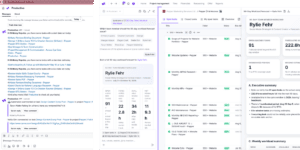
- Scheduling and project management. Tools like Productive use built-in AI to help with things like invoicing, budgeting, and workload tracking behind the scenes.
None of this replaces the parts of the job that actually require a human: the strategy calls, the client relationships, the creative decisions, the final say on what goes out under your name. That’s still very much us.
Where AI Actually Helps Our Work
Research and trend spotting
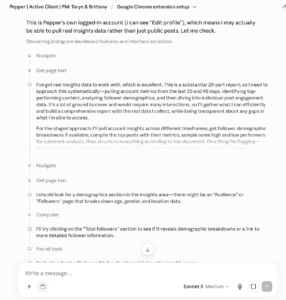
Before we write a single word of copy or build an ad set, we’re already on strategy calls and running our own research into your brand, your audience, and your goals. AI comes in after that groundwork, helping us move faster through competitor analysis, website performance data, and ranking research using tools like Ahrefs, Ubersuggest, and Semrush. It also helps us assess social engagement and reviews to understand what your audience actually responds to. Think of it as a very fast research assistant with zero opinions of its own. The starting questions and the strategic direction still come from us.
Ideation and brainstorming
We use Claude to generate a first pass at content angles, blog topics, or campaign directions. It’s a brainstorming partner, the kind that throws out ten ideas and doesn’t get offended when we throw eight of them out. Every idea gets filtered through what we already know about your brand and your customers before it goes anywhere near a client deliverable.
First drafts and outlines
Sometimes AI gives us a rough outline or a starting draft. It’s a skeleton, not a finished person. Our team rewrites it in your brand voice, checks it against your goals, and shapes it into something that actually sounds like you, not like a template with your logo pasted on top.
Reporting and data summaries
Claude helps us pull together ad performance and analytics data into readable summaries, especially for larger data sets that would otherwise eat hours of admin time. That means more of our time goes into interpreting what the numbers mean for your strategy, not fighting with a spreadsheet at 11pm.
Scheduling and workflow tools
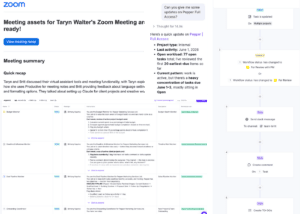
Behind the scenes, Productive, our project management and CRM system, uses built-in AI agents to help with things like invoicing, budgeting, and workload tracking. Zoom’s AI transcription helps our team capture strategy calls accurately, so nobody’s frantically scribbling notes while trying to actually listen to you. These tools keep our operations running smoothly so we can spend more time on the work that actually needs a human, like being at your content shoot or on a call with you.

What AI Cannot Do Without Us
Brand voice & Strategy
We do feed your brand voice documentation into AI tools when it’s useful for research or drafting. But a human built that documentation in the first place, through onboarding questionnaires and strategy calls, and a human reviews everything that comes out the other side. AI works inside your voice. It doesn’t create it, and it never will on our watch.
AI can help us think faster and research wider. It can’t decide what’s actually right for your business. That comes down to your goals, your market, your customers, and timing, all of which take judgment, not just data.
Client relationships
There’s no AI tool that knows what you meant on a strategy call last Tuesday, or picks up on the thing you mentioned in passing that changes the whole direction of a campaign. That context lives with our team, and it stays there.
Graphic design, photography, and video
This is where we draw our hardest line, and we mean that. We don’t use AI to design your logo or your visual identity. That comes out of a real conversation with you about what your brand should look like, what it should feel like, and why, and our in-house designer builds it from there. We don’t use AI to generate photography, and we don’t use AI avatars in place of real people in your videos or reels. If it’s your voice, face, or business on camera, that’s genuinely you. Not a generated stand-in, not a synthetic version of you saying words.
We hold this line because these things are personal. A logo comes from understanding a business owner’s story, not a prompt. A video works because of how someone actually sounds and moves when they talk about something they built with their own hands. That’s not something we’re willing to hand to a machine, and honestly, we don’t think you’d want us to either.

Creative direction
Whether something looks right, feels on-brand, or will actually land with your specific audience is a judgment call. We make it, every time.

Final approval
Everything published under your brand has been reviewed, shaped, and signed off by a human on our team. AI doesn’t have the last word here. We do.
Original insight
The thinking behind your strategy comes from experience working with real businesses, not from a model predicting the next likely sentence.
How We Protect Your Brand Voice
Brand voice is how your business sounds: on your website, in your captions, on a sales call. It’s word choice, tone, what you say and what you’d never say. It’s a big part of why customers recognize you and trust you, and it’s the first thing that goes generic the moment an agency leans too hard on AI. You’ve probably scrolled past a dozen posts that all sound like the same friendly robot wrote them. We built our process specifically so that never happens to you.
Before we write anything, we run a thorough onboarding questionnaire specific to your service, followed by a strategy call where we talk through who you are, who you’re speaking to, and how you want to sound. We also do our own research into your audience and how your current and potential customers already talk about you. All of that gets documented and housed in a working project, so every piece of content we create afterward gets checked against it rather than reinvented from scratch every time.
AI tools work inside those guidelines; they don’t set them. When we use AI for a first draft or an idea, it’s working from your documented voice, not a generic template, and a human on our team reviews it against that same documentation before anything gets close to publication.
Generic AI output is easy to spot, and honestly, kind of embarrassing when a business publishes it. It’s the marketing copy that could belong to any business in any industry: same structure, same phrases, nothing specific to the brand behind it. Our process is built to catch exactly that. If a draft doesn’t sound like you, specifically you, it gets rewritten until it does. That review step is non-negotiable, every time, for every client.
If you want to see how we build out brand voice and identity from the ground up, that’s a core part of our branding and visual identity work.
What This Means for Your SEO, Content, and Ads
SEO
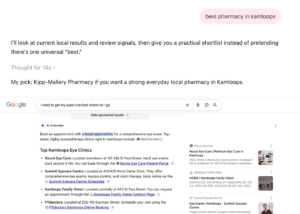
Google has been clear on this: it doesn’t penalize content because AI assisted with it. It targets low-quality content, whether that’s AI-generated or not, and rewards work that’s original, accurate, and genuinely helpful. The real question isn’t whether AI touched a piece of content. It’s whether the finished result is worth a reader’s time.
Content
Anything published under your brand is shaped, edited, and approved by someone on our team who knows your voice. AI may support that process, but it definitely doesn’t run it. That’s the same standard we apply across all our content creation work.
Ads
Humans make the calls that matter: strategy, audience selection, budget, creative direction, and what the results actually mean for your next move. AI may help summarize a report or flag a pattern worth a second look, but human judgment stays responsible for every decision built on top of that, including in our digital ads work.
A Note on Ethics
We believe transparency isn’t optional when it comes to AI, and 90% of consumers agree: a recent Clutch survey found that’s how many people want brands to disclose their use of AI. That’s why we’re writing this blog in the first place, and not because we got caught doing something we’re not proud of. You’re trusting us with your brand and your marketing budget, and that trust depends on knowing how the work actually gets made.
Part of that is being clear about data. We never feed confidential client information into AI tools. What we do use is information you’re already comfortable being public: your website content, your questionnaire answers, your brand voice, your audience and customer details. Anything that stays confidential lives in our project management system, not in an AI tool.
We’re not interested in using AI to create a false impression of who’s doing the work, or to pass off AI output as something a human carefully built. As AI becomes a bigger part of how every agency operates, whether they admit it or not, we’d rather be straightforward about where it fits into ours than let you guess and find out later.
How This Looks in Practice
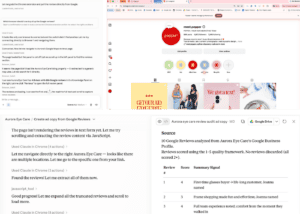
Here’s a real example, not a hypothetical. When we’re building out a client’s target personas, we use Claude to analyze their social media accounts and Google Business Profile reviews. It reads through comments, engagement patterns, and review language to surface what customers actually like, what frustrates them, and what makes them choose one business over another.
That’s genuinely useful, and it’s also just the raw material. Our team takes that research and decides what it actually means: who the real target customer is, what matters to them, and how that should shape the copy, the ad targeting, and the content we create. AI can tell us that a lot of reviews mention fast response times. It can’t tell us that this means the brand should lead with reliability over price in its ads, or that this particular audience responds better to a direct tone than a playful one. That’s a strategic read only our team can make, based on knowing the client and the market they’re in. No amount of pattern-matching gets you there on its own.
It’s a small example, but it’s a good one, because it shows the actual shape of how we work: AI does the heavy lifting on research and pattern-spotting, and our team does the thinking that turns it into a strategy that’s actually right for your brand.

Frequently Asked Questions
- Does Pepper use AI to write my content?
AI may support the early stages of content creation, like research or a rough first draft. Every piece published under your brand is written, edited, and approved by a human on our team who knows your voice. You never receive raw AI output, and you never will.
- Will AI change the way my brand sounds?
No. Your brand voice is documented through onboarding questionnaires and strategy calls before AI is ever involved. AI works inside that documentation, and a human reviews everything against it before anything gets published.
- Is AI-generated content bad for SEO?
No. Google doesn’t penalize content because AI assisted with it. It targets low-quality or unhelpful content, regardless of how it was made, and rewards original, accurate, and genuinely useful content.
- How do I know whether my marketing agency uses AI responsibly?
Ask directly. A responsible agency should be able to explain exactly where AI fits into its process and how humans review the work before it reaches you. If an agency can’t answer that clearly, or gets weirdly defensive about the question, that’s worth noticing.
- What is the difference between AI-assisted and AI-generated content?
AI-assisted content means a human uses AI for part of the process, like research or a first draft, then applies judgment, editing, and expertise before anything is finished. AI-generated content skips that step and goes from AI output to publication with little to no human involvement. We only work the first way. Every time.
- What AI tools does Pepper use?
We use Claude and ChatGPT for research, ideation, and reporting support, Productive’s built-in AI features for project and task management, Zoom’s AI transcription for call notes, and Google Workspace tools for research. None of these tools make creative or strategic decisions. Our team does.
- Does Pepper share my business information with AI tools?
We only use information you’re already comfortable being public, like your website content, brand voice, and audience details from your questionnaire. Anything confidential stays inside our project management system and never goes into an AI tool.
Want to Work with an Agency That’s Honest About How It Works?
We’re built on transparency, real strategy, and actually showing up for the businesses we work with. If you want a team that uses every tool available, including AI, without losing the human thinking your brand actually needs, let’s talk. Book a free call or see our services.