If you’ve seen SEO, AEO, GEO, AIO and LLMO in the same week and wondered whether marketers ran out of vowels, you’re not alone.
Here’s the good news: you don’t need to learn five new jobs. SEO vs AEO vs GEO sounds like a showdown, but all three mostly describe one job. Make sure the right people can find your business, and trust what they find, whether they’re scrolling Google or asking ChatGPT.
Some things have changed. People now get answers straight from Google’s AI summaries and from chat tools, often without visiting a website at all. That’s what AI search optimization is about. But the foundations underneath haven’t moved, and Google itself says optimizing for AI search is still SEO.
This guide explains each term in plain English, shows you what changed (and what didn’t), and ends with what to do this month.
The short answer: SEO (search engine optimization) helps you rank in search results. AEO (answer engine optimization) helps you become the direct answer. GEO (generative engine optimization) helps you get recommended inside AI-written answers. All three sit on the same foundations, which is why Google calls them all still SEO.
The quick version: SEO vs AEO vs GEO at a glance
Short on time? Here’s the whole idea in one table. Each row is a different place your business can show up online.
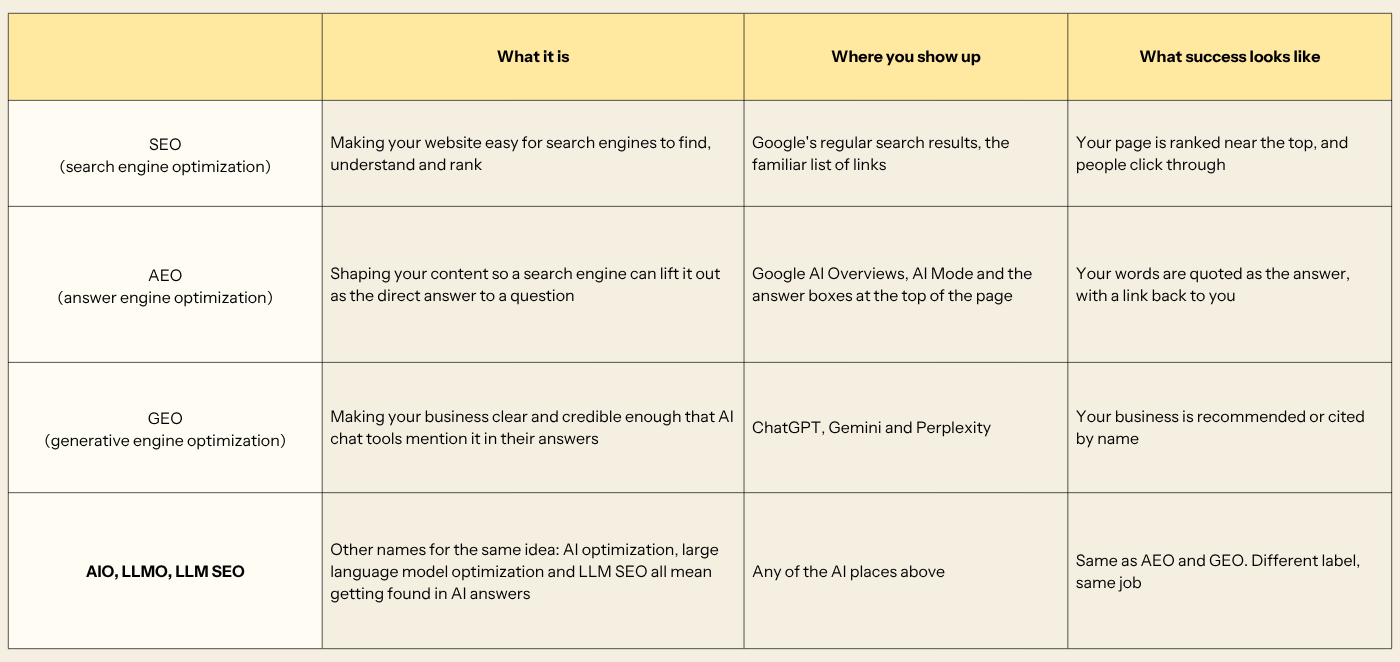
See the pattern? Every row asks the same three things of your website: be clear, be accurate and be easy to trust.
How search works now
Not long ago, finding a business online meant one thing: search Google, scan the links, click. Now people look in not one, not two, but three places!
The first is Google’s regular results. The second is Google’s own AI features: AI Overviews, the summary that often sits above the links, and AI Mode, a chat-style search inside Google. The third is AI chat tools like ChatGPT, Gemini and Perplexity, which answer a question in full sentences.
The numbers show the shift. From January to April 2026, 68% of US Google searches ended without a click to any website (SparkToro). Meanwhile, more than a billion people use ChatGPT every week (OpenAI, 2026).
If that feels like a lot to keep track of, picture a library.
Google’s results are the shelves, and you want to be ranked where people can see you. AI Overviews and AI Mode are the librarian reading out a quick answer, and you want to be quoted. ChatGPT, Gemini and Perplexity are a well-read friend, and you want to be recommended. AI agents, tools that take action on your behalf, are the friend who goes and books it for you. There, you want to be chosen.
Ranked, quoted, recommended, chosen. The rest of this guide comes back to those four words.
What is SEO?
SEO, or search engine optimization, is the work of making your website easy for search engines like Google to find, understand and trust. When it’s done well, your pages show up when people search for what you offer. It covers what’s on your pages, how your site is built and how other sites talk about you.
In the library, SEO is how your book ends up on the right shelf, at eye level, with a clear title on the spine. Google’s results work the same way. People tend to choose from the first few links, and few scroll far past them.
If you’ve paid for SEO before and couldn’t point to a single new customer from it, that’s worth naming. Good SEO is measured in calls and enquiries, not just rankings in a monthly report.
What success looks like: you’re ranked. Your page appears near the top for the searches your customers make, and some of those people click through to you.
What is AEO (answer engine optimization)?
AEO, or answer engine optimization, is shaping your content so a search engine can pull it out and use it as the direct answer to someone’s question. On Google, that means showing up in AI Overviews, AI Mode or the answer box at the top of the page, often with a link back to your site. In marketing, AEO comes down to one goal: being the answer.
In the library, AEO is the librarian. Someone asks a question at the desk. Instead of pointing to a shelf, the librarian reads out a short answer from one book and says where it came from. You want it to be your book.
The pages that win here answer a real question clearly, near the top, in plain words. Picture “How long does a roof replacement take?” answered in the first two sentences, not buried in the fifth paragraph.
What success looks like: you’re quoted. Your words appear as the answer, with your business named as the source.
What is GEO (generative engine optimization)?
GEO, or generative engine optimization, is making your business clear, consistent and credible enough that AI tools mention it when they write an answer. “Generative” means the tool writes a fresh response each time, instead of showing a list of links. Think ChatGPT, Gemini and Perplexity.
PSA: GEO here has nothing to do with geography or geographic targeting. Same letters, different meaning.
In the library, GEO is the well-read friend. You ask, “Who should I call about my website?” and they don’t hand you a list. They name two or three places they trust, based on everything they’ve read and heard. To get named, your business needs to show up clearly and consistently in the places they read: your website, your Google Business Profile, reviews and directories.
What success looks like: you’re recommended. Your business is named or cited when someone asks an AI tool about your category.
AEO vs SEO: what’s the difference?
AEO vs SEO comes down to where you’re competing. With SEO, you’re competing for a spot in the list of links. With AEO, you’re competing for the answer that sits above that list.
That changes what a win looks like. A top ranking used to mean a steady stream of clicks. Now the answer above the links often satisfies the searcher first. In a 2026 field experiment, AI Overviews cut clicks to websites by more than a third on the searches where they appeared (Agarwal and Sen, 2026).
It also changes how you write. SEO rewards a page that covers a topic well overall. AEO rewards a page that answers one specific question clearly and early, so it’s easy to lift out.
The two aren’t heated rivals. Google builds its AI answers from the same index and ranking systems behind its regular results, so a page that ranks well has a better shot at being quoted too.
What this means for you: keep doing SEO, and make sure your key pages answer your customers’ real questions in the first few lines.
GEO vs SEO: what’s the difference?
If you’re wondering what GEO vs SEO means in practice, it comes down to what you’re trying to earn. SEO earns a click. Someone sees your link, visits your site and decides from there.
GEO earns a mention or a citation inside an AI tool’s answer, and often there’s no click at all. The person reads your name in the answer, then calls you, searches for you or remembers you later.
That makes GEO harder to measure. It doesn’t always show up in your website traffic, so you check it a different way: by asking the AI tools directly (more on that further down).
The groundwork overlaps more than the names suggest. Many AI tools search the web before they answer, and all of them need clear, accurate information to work from. If your website is thin or your details don’t match across the web, neither Google nor ChatGPT has much to go on.
What this means for you: GEO isn’t a separate project. It’s SEO, plus making sure your business is described the same way everywhere it appears.
AEO vs GEO (plus AIO, LLMO and LLM SEO)
Our honest answer, no bullshit answer: the line between AEO and GEO is blurry, and marketers don’t all draw it in the same place. Roughly, AEO leans toward a search engine giving one direct answer. GEO leans toward an AI chat tool writing a longer response that might recommend a few businesses. Google’s AI Mode does a bit of both, and the work behind them is nearly identical.
Then there are the other names like LLMO (large language model optimization) and LLM SEO describe the same goal from the technology side.
AIO, short for AI optimization, is the term we use at Pepper. It’s our umbrella for all of it: getting your business found and described accurately in AI-written answers, wherever they appear. You may also see AIO used for Google’s AI Overviews, or as the name of a WordPress SEO plugin. Same three letters, different things. It’s why our SEO and AI optimization services treat all of this as one job.
If someone pitches these to you as separate services, ask what’s different about the work. Usually, not much!

Where do LLMs fit?
An LLM, or large language model, is the technology underneath AI tools like ChatGPT and Gemini. It’s trained on huge amounts of text, which lets it understand a question and write an answer that reads like a person wrote it. Google’s AI Overviews and AI Mode run on the same kind of technology.
In the library (yes, we’re back there hehe), the LLM is everything the librarian and the well-read friend have learned over the years—okay smartie pants. It’s what lets them answer at all!
So here’s the line worth remembering, and don’t forget it: LLMs aren’t a strategy! They’re where the answers come from. You don’t optimize for an LLM directly. You make sure the information it learns from, and looks up, about your business is clear, accurate and easy to find.
AI agents: from answering to doing
Chat tools answer questions and AI agents go a step further and do things. An agent is an AI tool that carries out a task for someone: comparing three local options, checking availability, booking an appointment or making a purchase. Some already do this by opening websites and reading them much like a person would.
In the library, this is the friend who doesn’t just recommend a restaurant. They call and book the table for you.
For an agent to choose your business, it needs facts it can rely on: your services, prices or price ranges, hours, location and how to book. Those facts should be stated clearly and match everywhere they appear. A website that’s easy for people to use, including people using screen readers, tends to be easier for agents too.
Google calls preparing for agents optional for now, worth exploring if it’s relevant to your business and you have time. So this isn’t urgent. Getting ready is sometimes called agentic SEO, and buying through agents is called agentic commerce. When agents become common, businesses with clear, consistent information will be the easiest to choose.
What success looks like: you’re chosen. The agent picks your business and books it.
The SEO foundations that power all of it
Five basics do most of the work, for Google and AI tools alike. This page uses every one of them, so you can see each one in action as you read.
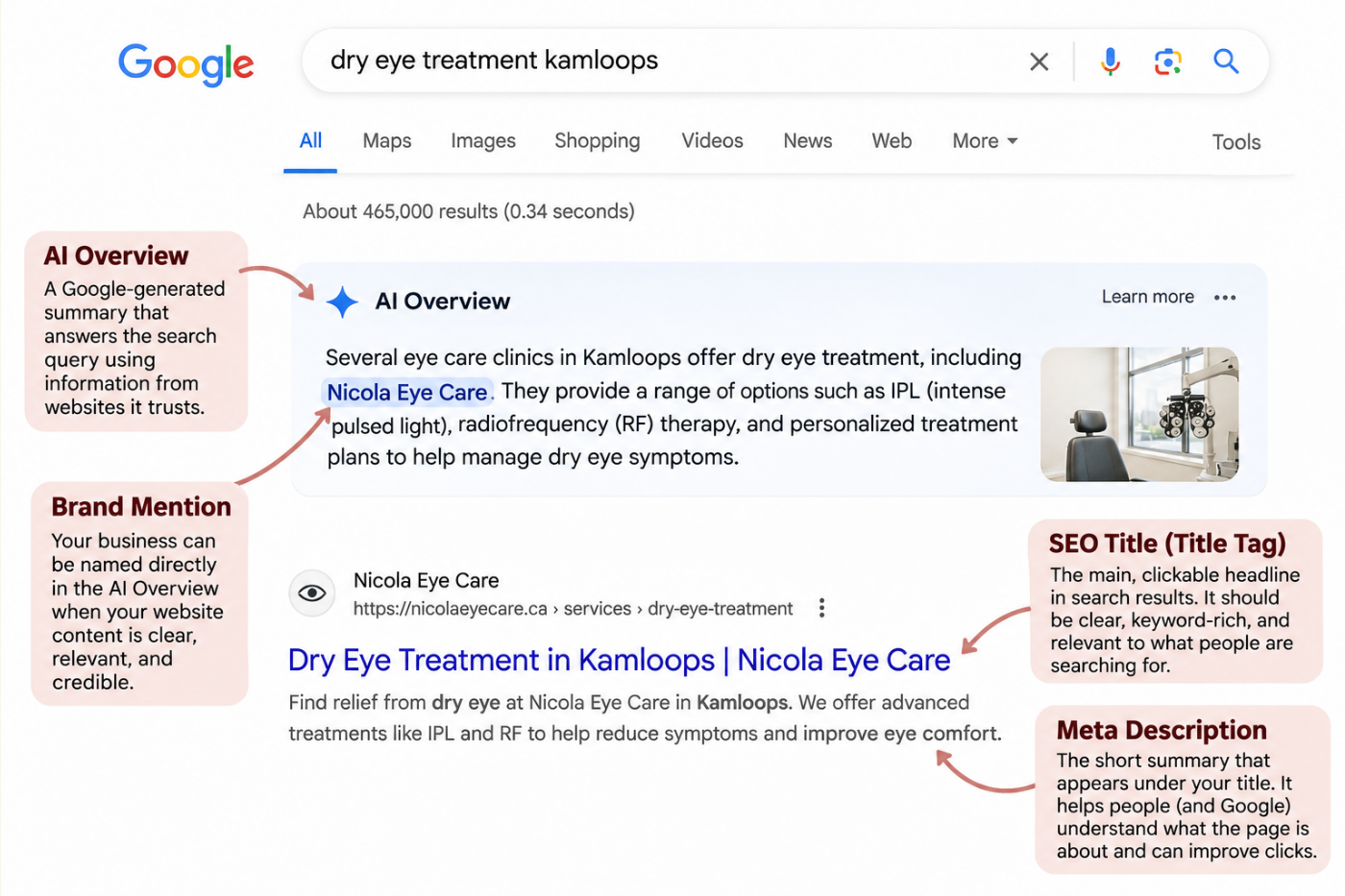
SEO titles (title tags)
An SEO title, also called a title tag, is the clickable headline for your page in search results. You set it in your website’s settings, separately from the headline people see on the page. In the library, it’s the book’s spine: the first thing anyone reads on the shelf, and sometimes the only thing.
Example:
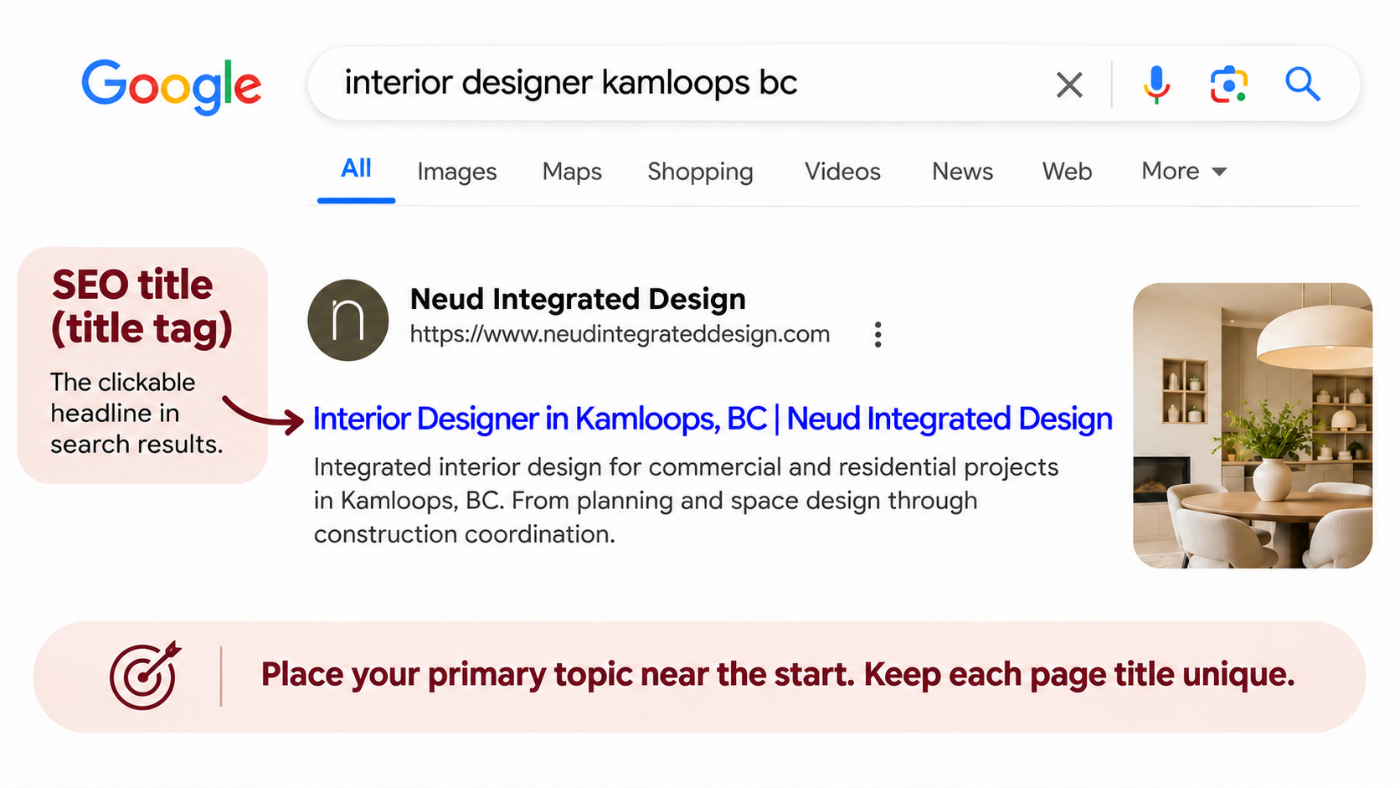
It’s 57 characters, so it won’t get cut off, and it says plainly what the page covers. Aim for under 60 characters, with your main topic near the start.
Why it matters for AI too: the title is one of the clearest signals of what a page is about, for Google and for AI tools that search the web before they answer.
Meta descriptions
A meta description is the short summary that often appears under your SEO title in search results. It’s the back-cover blurb. It doesn’t decide where the book sits on the shelf, but it helps someone decide to pick it up. Google sometimes writes its own, but a good one gives you a say.
Example:
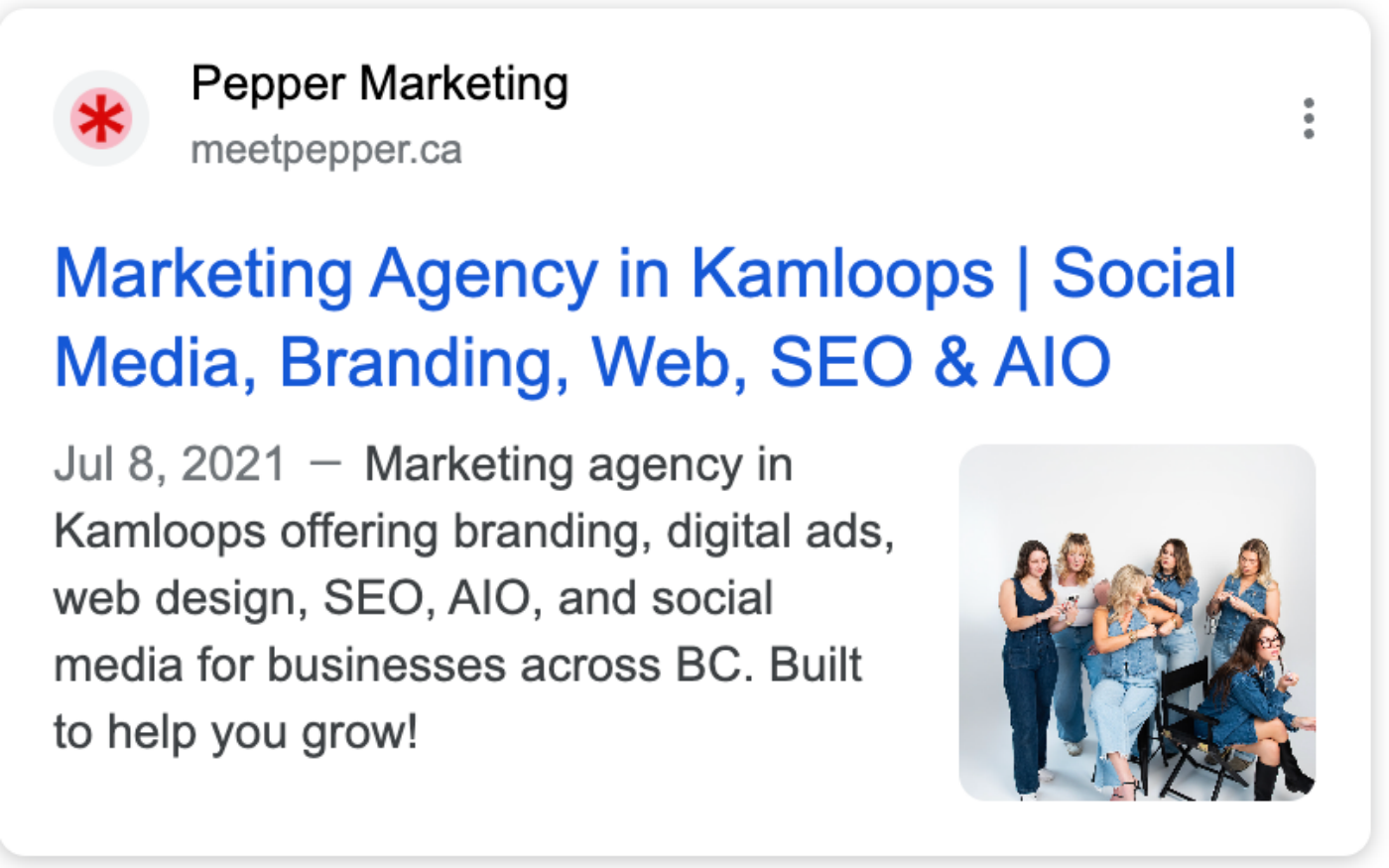
Aim for about 150 characters that tell people what they’ll get.
Why it matters for AI too: a clear summary helps any reader, person or machine, judge quickly whether a page answers the question.
Headings: H1, H2 and H3
Headings break a page into sections. The H1 is the main title, and each page should have one. H2s are the main sections, and H3s are the subsections inside them. In the library, they’re the chapter titles and subheadings that let you flip straight to the part you need.
On this page: the heading you just read is an H3. The section it sits in is an H2. The title at the very top of the page is the H1.
Why it matters for AI too: clear headings, especially ones phrased as questions, show Google and AI tools where each answer starts. That makes your answers easier to find and quote!
Alt text
Alt text is a short written description of an image, added in your website’s settings. Its first job is accessibility. People who are blind or have low vision use screen readers, which read the alt text aloud. Think of it as describing a photo to someone over the phone. Search is the bonus!
Example:

Why it matters for AI too: search engines can’t see images the way people do, so alt text tells them what’s in the picture. And some AI agents read pages much like a screen reader does, so an accessible site is easier for them too.
Schema markup
Schema markup is a bit of code that labels the facts on your page so machines don’t have to guess: this is the author, this is the date, this is the phone number. In the library, it’s the catalogue card, the neat record the librarian checks before opening the book.
On this page: in plain words, this page’s schema says it’s a blog post on meetpepper.ca, written by Pepper, published on [date] and last updated on [date]. It also lists the frequently asked questions at the bottom, with their answers.
Example:
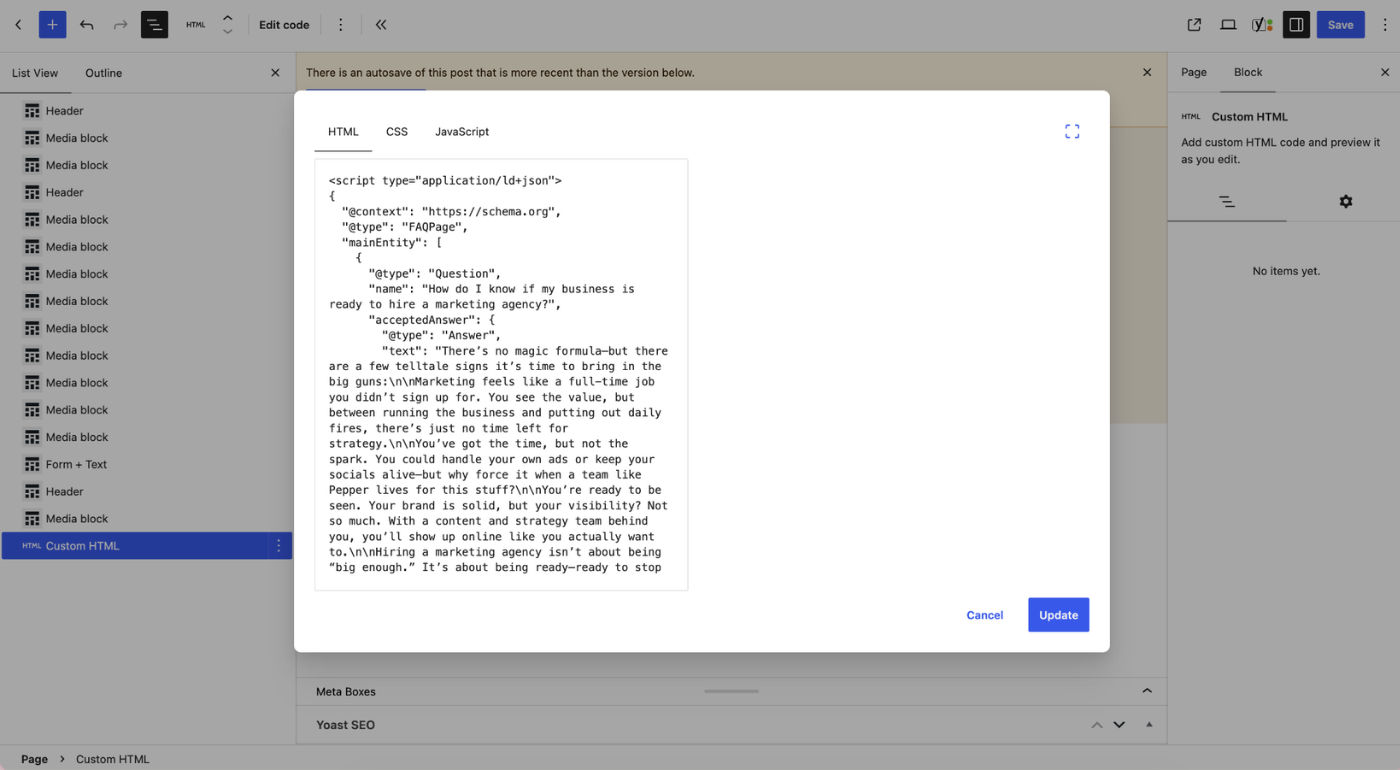
Why it matters for AI too: schema helps machines read your page accurately. But there’s no special AI schema. Google actually says schema isn’t required for its AI features. It’s still worth adding as part of good SEO, because it can help your pages qualify for richer results in Google and other search engines.
What you can skip
If someone is selling you an AI-specific fix, check it against this list first! In its May 2026 guide, Google named tactics you don’t need for its AI features:
- An llms.txt file. This is a text file meant to guide AI tools. Google Search doesn’t use it, and in May 2026, 97% of these files got zero requests from anyone (Ahrefs).
- Special “AI schema.” There isn’t any.
- Chopping content into chunks. Write for your readers, there’s no ideal page length.
- AI-specific rewrites. AI tools understand synonyms and plain meaning, so you don’t need to repeat every keyword variation.
Save your budget for the basics above. They do the heavy lifting for Google and AI alike!
How we check whether AI recommends a business
GEO doesn’t always show up as website clicks, so we check it directly. We use a tool that asks AI platforms the questions real customers ask, then records which businesses get named. We run it for clients, and we run it on ourselves.
Across the 20 questions we tracked for one of our clients in the optometry & eye care market, they appeared in 83% of AI answers over 30 days as of November 23, 2026. That made them the most-mentioned of 196 brands in those answers.

You can run a simple version yourself, too! Ask ChatGPT and Gemini what your customers would ask, and see who gets named. If you’re curious, here’s how we use AI ourselves! 👀
What to do this month: a 7-step checklist
You don’t need to do everything at once. This is where we’d start.
- Give every page a unique SEO title and meta description. Start with your homepage and main service pages.
- Use one H1 per page and a logical H2 and H3 structure. Your headings should read like a table of contents.
- Add meaningful alt text to your images. Describe what’s there, as if to someone over the phone.
- Answer your customers’ real questions directly on your site. Put the answer in the first line or two.
- Keep your business details identical on your site, Google Business Profile and directories. Same name, address, phone number and hours everywhere.
- Add basic schema. Use Organization, or LocalBusiness if you serve customers in a specific area.
- Ask ChatGPT and Gemini about your category. See whether you come up, and who comes up instead.
If you’d rather hand this off, our SEO and AI optimization services cover all seven. You can reach out for a free discovery call to chat about your website anytime.
Frequently Asked Questions
- Is SEO dead?
No! It’s the foundation everything else sits on. Google’s AI features are built on its core search ranking systems, and AI chat tools still rely on clear, findable websites. The work has grown, not disappeared.
- Is GEO the same as SEO?
Mostly. GEO aims to get your business recommended in AI-written answers, while SEO aims for rankings and clicks. They run on the same foundations, which is why Google says it’s all still SEO.
- What does AEO stand for?
Answer engine optimization. It means shaping your content so search engines can use it as the direct answer to a question, like in Google’s AI Overviews.
- Does GEO mean geographic?
No, not here. In this context, GEO stands for generative engine optimization. It has nothing to do with geographic targeting, though local businesses benefit from it, too.
- How long does it take to show up in AI answers?
There’s no fixed timeline. Changes to your site have to be found and processed first, which can take weeks. Building the trust that earns recommendations usually takes months, much like SEO.
- Can I pay to be recommended by AI?
You can pay for ads. ChatGPT, Google’s AI Overviews and AI Mode now show ads, labelled as sponsored. But you can’t buy a place in the answer itself. Both OpenAI and Google say ads don’t influence their AI’s answers.

Five acronyms, one job.
Whether someone scrolls Google, reads an AI summary, asks a chat tool or sends an agent to book, the businesses that win are the clearest and easiest to trust. Get the foundations right and you give yourself a shot at all four: ranked, quoted, recommended, chosen!
Want a second pair of eyes? Book a discovery call! We look at where your site stands and tell you what we’d actually do. (New to agencies? Here’s what a marketing agency actually does.)