Why “just Google it” isn’t enough
Googling “best marketing agency near me” will get you a list, but it won’t necessarily get you the truth…
A search results page is basically speed dating for marketing agencies. Nice websites, polished portfolios, a few five-star reviews, and everyone putting their best foot forward. What it won’t tell you is what the relationship feels like three months in, whether you can reach a real person when something goes sideways, or whether the invoice still matches what you were promised on the sales call.
Here’s the thing: if you’re reading this, you’ve probably already decided you want an agency. What you’re actually trying to solve is a much harder question, which is: how do you tell the ones who’ll do right by you from the ones who’ll ghost you (and yes, that happens more than anyone likes to admit).
That’s what this is for. Not a pitch for Pepper, though we’re right here if you need us, bestie. This is a framework you can run any agency through, including us, so you walk into that first call already knowing what to ask and what to watch for.
Questions to ask before you sign anything
Before you sign anything, there are a few questions worth asking out loud, on the call, before you’re emotionally invested in the pretty slide deck they sent you.
Who owns what once the work is done
Ask who owns your website once it’s built, who has access to your advertising accounts and your analytics, and what happens to the photography, videos, designs, and templates made for your business if you ever walk away.
In a healthy agency relationship, every one of those questions has the same answer: it’s yours, and you can access it whenever you want. Not “we’ll get back to you on that.” It’s yours. Full stop.
How you’ll actually see results
Ask how results get reported, and more importantly, how that reporting ties back to your actual business goals, not just whatever number happened to look good that month. Different services measure success differently, and that’s normal. Organic social often leans on reach, views, and engagement because a straight line to a sale isn’t always there. Paid ads, SEO, and AI visibility usually offer a clearer path to leads and conversions. What you’re listening for is whether an agency explains underperformance with the same energy it uses to brag about a win.
Who you’re talking to, and how often
Find out who your actual point of contact is, how quickly they respond, and whether you’ll have any visibility into your account between scheduled check-ins. Then ask how the strategy gets built around your specific business, and who’s coordinating the different specialists on your account. Someone has to be doing that job, and it shouldn’t be you, and if it sounds like it might be, then that agency should be adding you to their payroll as a project manager.
None of these are trick questions. A good marketing agency will answer them without flinching. If you get a vague non-answer instead, file it away, because you’ll be asking again later… just with more frustration attached.
Red flags to watch for
Some marketing agency behaviours are dressed up as normal and quietly aren’t (seriously, you need to run).
Watch for anything that smells like overpromising: guaranteed results, or a strategy that could be handed to any business in any industry with just the name swapped out. Also no agency controls your entire funnel, so guarantees on leads, rankings, or revenue are a sales tactic, not confidence.
Then there’s control. Your accounts, your data, your creative assets should always be yours to access, no permission required. If an agency hides logins, drags its feet handing things over, or makes leaving feel like a breakup with someone who won’t return your calls, pay attention. A reasonable minimum commitment while a strategy gets time to work is normal, but no notice period or a deliberately messy offboarding process is not.
Transparency is what it all comes down to. Reporting should connect back to your actual goals, not just whichever number looked best that month. You should always know who your point of contact is and how fast they respond. Pricing and scope shouldn’t shift once you’re locked in. And if AI is quietly doing your graphic design, your photography, or work that’s supposed to be genuinely yours, that needs to be disclosed. You hired an agency, not ChatGPT. Using AI for research or admin isn’t the issue, because honestly, not using it at all is starting to look like the outlier. We’ve actually written a whole blog about exactly where we draw that line, if you want the long version.
What real transparency looks like in practice
Real transparency isn’t a line on an about page. It’s a handful of specific, checkable things.
It means you can log into your own accounts whenever you want, no email required first. Your website, your ad accounts, your analytics: you have access, period, and that access shouldn’t disappear the moment you offboard.
It means anything created for your business, your photography, your videos, your designs, your templates, actually belongs to your business. Not licensed to you, or held until you ask nicely. Yours, the same way it would be if you’d built it in-house.
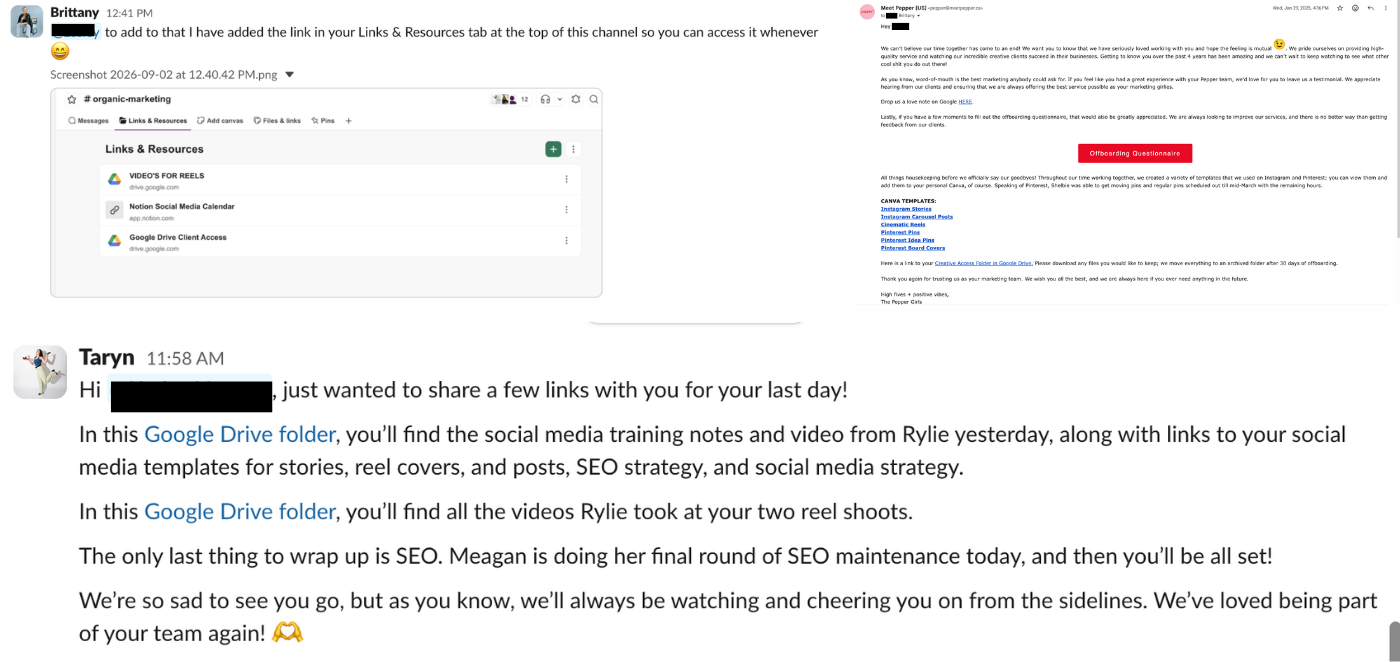
It means your reports actually mean something. A good marketing agency ties a number back to what you’re actually trying to achieve, and says so plainly when something underperformed instead of burying it under a metric that photographs better. If nobody can explain what a number means for your business, start asking some questions because you deserve to know!
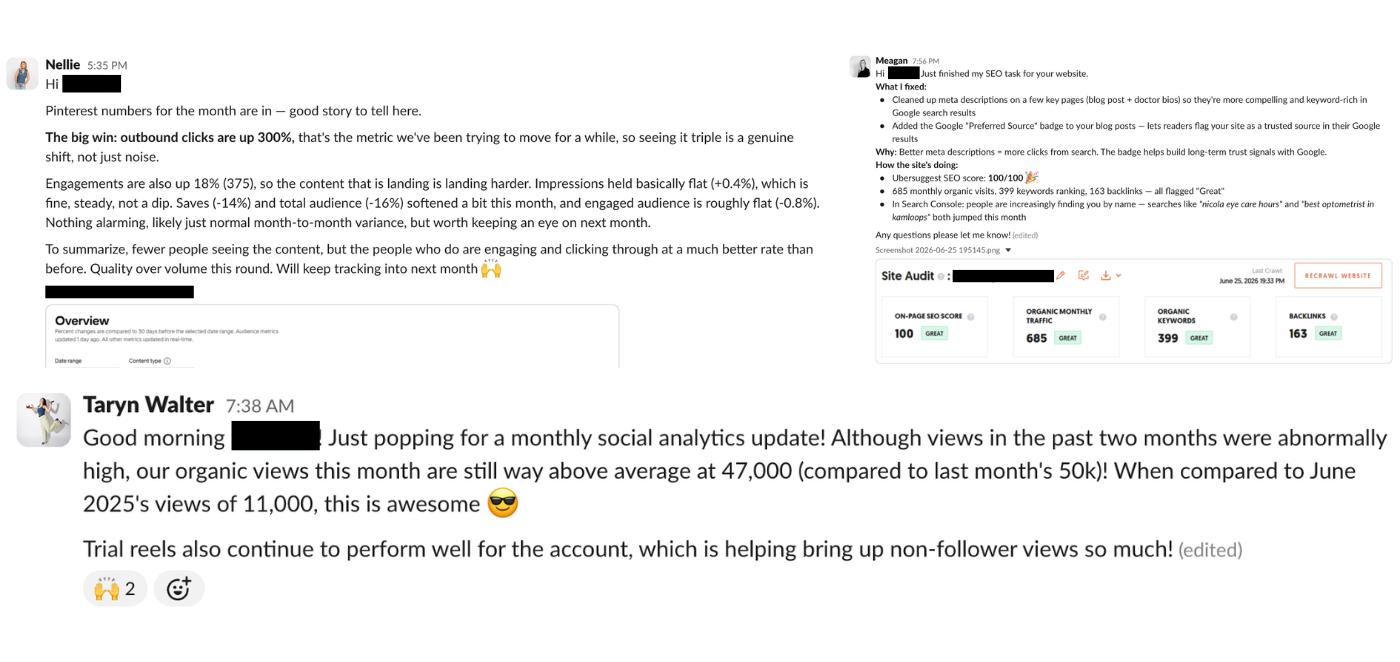
It means you’re not guessing who to talk to. You know your point of contact, roughly how fast they respond, and you’re not left wondering what’s happening between scheduled calls. And when something’s not working, a transparent marketing agency says so before you have to ask, and tells you what’s changing because of it.
That’s the whole definition, really. You understand what’s happening in your own marketing, at any point, without having to dig for it.
Agency vs. freelancer vs. in-house: which fits your stage?
When a freelancer makes sense
A freelancer could be the right call when you need one specific thing done well: a photographer for a photoshoot, a graphic designer for a logo, a copywriter for a website. But don’t forget we can do that too (;
It gets messier the moment you’re juggling more than one. A social freelancer here, an ads freelancer there, someone else building your site, and suddenly you’re the one making sure they’re all pulling toward the same goal, passing along brand guidelines, chasing deadlines, and catching it when nobody talks to each other. At that point, you haven’t just hired help, you’re now a marketing manager, congrats!
When in-house makes sense (and what it actually costs)
An in-house hire gives you someone whose full attention is on your business, and that’s genuinely valuable. The catch is range. One person being excellent at strategy, design, SEO, AIO, content creation, photography, copywriting, and ads at the same time is a lot to ask, and most marketers are naturally stronger in some lanes than others. And if they’re a jack of all trades, they’re probably an expert in none…
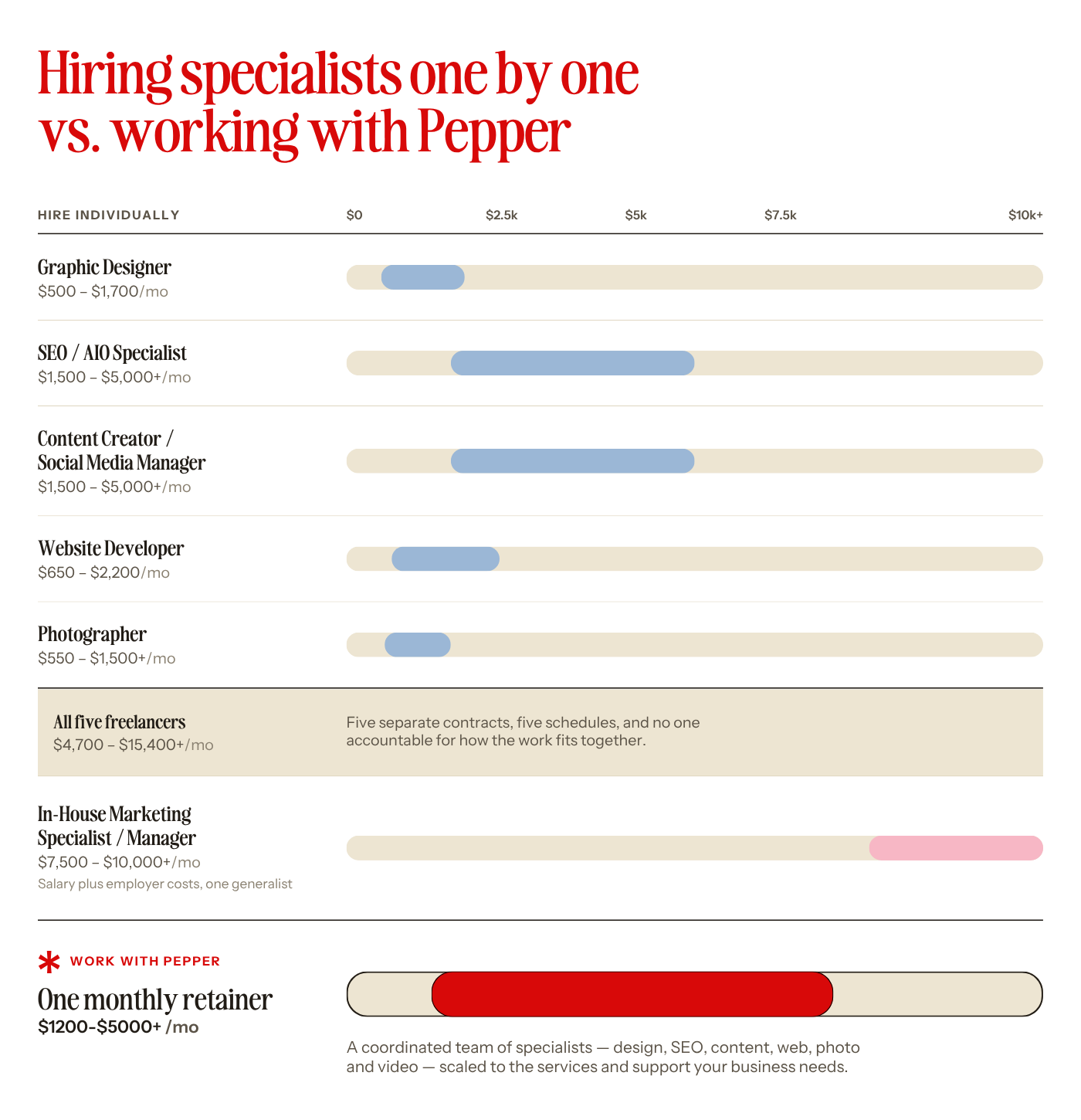
It’s also not the budget-friendly option people sometimes assume. An experienced in-house marketing hire typically runs $80,000 to $110,000+ per year before benefits and everything else that comes with an employee.
When an agency makes sense
An agency fits when your business needs several disciplines working together, and you’d rather not be the one holding it all together yourself. The value isn’t just having more hands on deck. It’s coordination, a shared strategy, one project manager keeping it consistent, and specialists who already know how to work with each other, because they do it every day.
That’s really the whole trade-off. Freelancers give you range without coordination. In-house gives you dedication without range. An agency is built to give you both.
How Pepper approaches this differently
We’re not going to pretend Pepper is the only marketing agency that gets this right. But since you’re already here, here’s the honest version of how we actually work.
Every Pepper client gets a project manager whose whole job is making sure the person handling your ads, the person writing your content, and the person designing your graphics are all working off the same strategy, not five separate to-do lists that happen to share a client name. Onboarding is where we learn your business, your goals, your brand voice, and your audience, so you’re not re-explaining yourself every few months.
Day-to-day, we work mostly through Slack, and you’ll hear back within roughly 24 to 48 business hours, usually sooner. Your website, ad accounts, analytics, and every piece of creative we make stay yours: full access, no asking permission. If something’s underperforming, we say so and tell you what we’re changing, instead of hoping you don’t notice.
Don’t worry, we don’t make leaving hard. For our retainer packages, we ask for a four-month minimum: one month to onboard properly, and three months to let the strategy do its job. Marketing needs a little runway before you start judging the landing! After that, it’s 30 days’ notice, and you’re out. We promise, it’ll be an amicable breakup, and we’ll still cheer you on from the sidelines.
And we’ll say this with our full chest: more than half of the clients who offboard eventually come back. We’re completely okay with that! Sometimes you want to try a different avenue, bring things in-house, test the DIY route, shift budgets, or see what else is out there. Business changes and priorities change, but our door stays open.
If you worked with Pepper before and your business reaches a point where you need us again, there’s no awkward “sooo… remember us?” conversation. Just come back, and we’ll pick up where things make sense and figure out what you need now.
Want proof of what long-term client relationships with Pepper actually look like? Our portfolio is the perfect place to find out. You’ll find real clients, real projects, and plenty of businesses we’ve worked with across different stages of their growth.
None of this makes us the only right choice for your business; it just means you’ll know exactly what you’re getting before you sign anything. Which, since you’re here, is probably all you actually wanted to know.
If any of this leaves you with more questions than answers, that’s what we’re here for. Get in touch and let’s talk it through!

Frequently Asked Questions
- What questions should I ask before hiring a marketing agency?
Ask who owns your website, ad accounts, and creative assets once they’re built, how results get reported, and who your actual point of contact will be. If an agency can’t answer these clearly before you sign anything, that’s information in itself.
- How do I know if a marketing agency is being transparent with me?
You’ll have access to your own accounts and data without asking permission, reporting that connects to your actual goals, and a team that tells you when something didn’t work, not just when it did. Vague answers on any of that usually preview what the relationship will feel like.
- What’s the difference between hiring an agency and hiring a freelancer?
A freelancer is built for one specific task done well. An agency coordinates multiple specialists under one strategy, so you’re not the one connecting the dots between your website, your ads, and your content.
- How much should a small business expect to pay a marketing agency?
It depends heavily on scope and services, but as a general range: an experienced in-house hire runs $80,000 to $110,000+ per year before benefits, several freelancers can run $5,000 to $15,000+ per month, and agency retainers, including Pepper’s, typically fall between $1,200 and $5,000+ per month depending on what’s included. Get a proposal that matches your actual budget and goals before comparing sticker prices.
- What are common red flags when choosing a marketing agency?
Guaranteed results, restricted access to your own accounts or assets, cherry-picked reporting, a strategy that could belong to any business, contracts that make leaving difficult, and undisclosed AI use in creative work are the ones worth watching for most closely.
- Should my marketing agency tell me if they use AI?
Yes, especially anywhere creative. Most agencies use AI somewhere in their process now, research, admin, first drafts, and that’s not the concerning part. What matters is whether they’re upfront about where it’s used and where it isn’t, particularly for your graphics, photography, and video. We’ve written our own breakdown of exactly where we draw that line.